
Monday, January 20, 2014
LAD #26: MLK's 'I Have a Dream' Speech
Martin Luther King Junior's 'I Have a Dream' speech is easily one of the most known speech in America. He starts off by referencing Lincoln and the Emancipation Proclamation when the slaves were set free. Then he states that 100 years later, African Americans are still being discriminated against and not able to live completely free lives. He then continues explaining all the bad things that African Americans go through, and says now is the time to do something about it. He explains that African Americans will not keep living in these conditions and will not stop until justice is served. He says that they will not turn to physical violence but they will not stop until they are given their complete freedom. He then talks about the dream he has for the country, the dream that one day nobody will be judged by their skin color but by their character. He dreamed that one day blacks and whites would live together in peace.

Sunday, January 19, 2014
LAD #26: Cross of Gold Speech
William Jennings Bryan, a democrat from Nebraska, gave the speech called the “Cross of Gold” and after this speech was given in 1896 Bryan was nominated to run as a candidate for the 1896, 1900 and 1908 elections by the democratic national convention. Bryan spoke in favor of a highly controversial topic in the United States: Bimetallism, the idea that both gold and silver should be coined instead of just gold. It would be the speech that would rocket him into the presidential nomination for the Democratic party. Bryan states that the Democrats are using this speech only to make public their position of the topic so that those who agree with their position may join them. Bryan supports the bimetallism because he supported more of the common man and the farmer who would benefit from it.

LAD#26: Populists Party Platform
The Populists Party Platform started in the 1890's as a third party for the working man. It was strongly opposed to the big business, banking system, and corruption that was taking over America. They worked to create equality in America and tried to decrease the large gap between the rich and the poor. One of the main goals of the platform was to increase the standard of living for factory workers and to get the bread and butter of the labor, better conditions, better hours, better pay. They believed the government should play a role in the railroad companies and increase income taxes. The party was all for the common man and favored labor unions.

LAD #25: Dawes Act
The Dawes Act was made to re-organize and redistribute reservation land into land for individual Indians, their own private property. Native Americans 18 and above, including orphans, got 1/8 of a piece of land, while adults in charge of a family will get 1/4th- of which they could stay on or sell. The land is supposed to be used to produce crops or for animals to graze. Dawes Act also includes laws for the reservation- Indians can apply to become American citizens and work for the government. The land, if there is not enough, is divided by a class system and also by an agent, who would give out patents of ownership. Indians who don't live on reservations can ask and apply for land. Once they've stayed on the land for five years, the land is forever theirs.

Thursday, January 9, 2014
LAD #22: McKinley's War Message
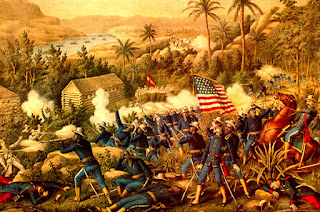
McKinley stated to congress that the war between Cuba and Spain was now affecting the American citizens. He stated that the people were shocked by the atrocities taking place in the war. In addition, it was affecting the American economy as well. The United States had a large amount of trade with Cuba and the war that was going on was damaging the trade relations. McKinley goes on to say that the war has dragged on for three years and there is still no clear winner yet. He thought that it was necessary for the United States to either act as a neutral nation to help solve the problem, or act as a military ally to one of the countries. McKinley believed the U.S. needed to intervene because we needed to stop the bloodshed, we needed to protect the citizens of Cuba, protect our trade, and protect our own government and freedom.
Wednesday, December 11, 2013
LAD #21: Carnegie's Gospel of Wealth
Carnegie begins by asserting the development of society that has centralized wealth in the hands of few, whose mansions rise above everyone's cottages. The centralization of this wealth was actually for the good, so we would not all be poor and the rich can remain rich as long as they help society through three modes of contribution. His first mode would be leaving it to your family which to Carnegie was not ideal since it actually put a burden on their family on what to do with their wealth. Another is to give all your money to society only when you are dead, which shows that you were too selfish in society to make donation. The ideal mode of contribution would be to make public donations during your lifetime while he also supported death taxes on estate.

Monday, November 25, 2013
LAD #2:Emancipation Proclamation
In this Doctrine, which went into effect on December 2, 1823, was a statement made by the United States to all of the European powers. In this statement, the Untied States said that none of the European powers were to try and colonize any far of the New World from here on in. The United States, along with Russia and Great Britain believed that it was time for the European powers to end their colonial ventures in the new world and to keep their affairs domestic. The U.S urged that an attempt to colonize nations in the New World would present a threat to American security and the Americans would take appropriate action. The United States recognized many nations such as Mexico and Chile and bolstered a new era of Independence in the New World.

Subscribe to:
Posts (Atom)